
Attraction
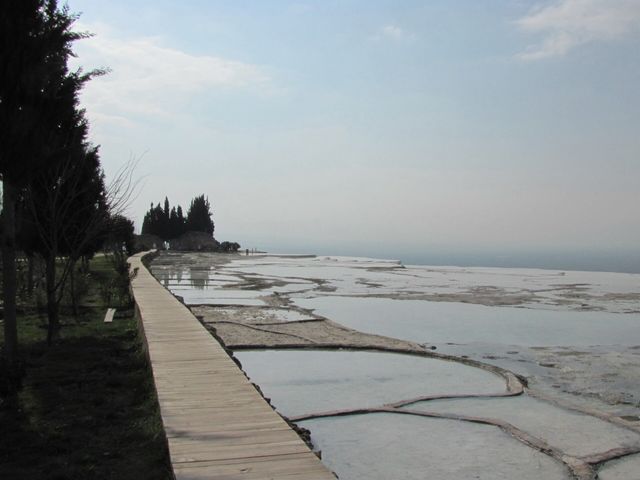
The Travertines of Pamukkale
Pamukkale's white travertine terraces: the can-you-swim rules, the barefoot policy, why some pools are dry, the best time of day, and how to visit.
Swim among sunken Roman columns at Pamukkale's Cleopatra's Antique Pool: the separate price, what's included, the history behind the name, and whether it's worth it.
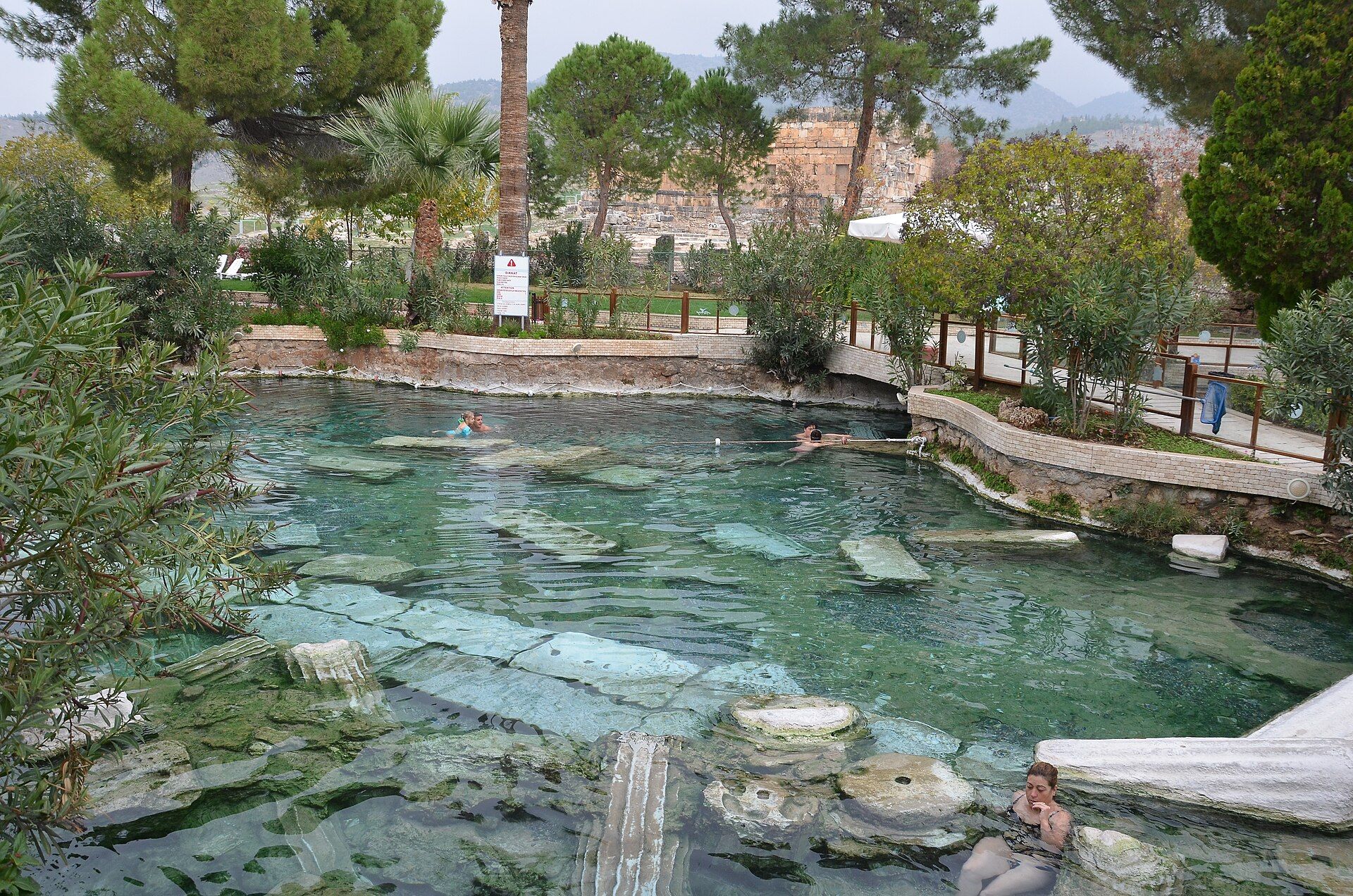
Last updated:Near the top of the travertines, tucked behind the ruins of Hierapolis, is the one place at Pamukkale where you can actually get into the water: a warm, spring-fed pool with chunks of ancient Roman marble lying across its floor. You swim over fluted columns and carved blocks in clear, faintly fizzy water that holds around 36°C, roughly body temperature, right through the year. It is about as close as you will come to bathing the way the Romans did, in the same spring, on the same ground.
It is also the single part of the site that costs extra, and opinion on it splits sharply. Google Maps reviewers rate it 4.2 out of 5 (2,742 reviews), below the terraces and Hierapolis, and understanding that gap is the key to deciding whether to get in or simply look.
The marble was not arranged for effect. It is the genuine wreckage of a Roman portico that toppled into the spring during an earthquake, most likely in the 7th century, and was left exactly where it fell. Those fallen columns are now the whole appeal: you can perch on a fluted drum with warm water at your shoulders, or drift slowly over the carved stone beneath you. The water is thick with dissolved minerals and gently effervescent, threaded with fine bubbles, and it is deep enough for a proper swim, with steps and handrails at the edges. The submerged marble underfoot is uneven and can be slippery, so people tend to move with care rather than stride about. It is a genuinely odd sensation, half swim and half archaeology, and it is why the pool has a reputation all its own, apart from the white slope above it.
Hierapolis, the Roman and later Byzantine city on the hill, was founded as a spa in the first place. Its hot, mineral-laden spring was the reason the city existed at all, drawing people to bathe and take the waters from antiquity onward, and this pool sits directly on that source. So the bathing here is not a modern gimmick bolted onto old ruins; it continues what the site was always for.
The “Cleopatra” in the name, though, is romance rather than record. No historical source places Cleopatra at Hierapolis; the tale that the pool was a gift to her is modern tourism branding, pinned on because a celebrated ancient spa and a celebrated ancient queen make a tidy pairing. The “antique” half of the name is honest, the Roman stone and the age-old bathing are real, but treat the Cleopatra thread as folklore that stuck, not as fact.
Yes, and swimming is the entire reason to come. The pool is open and in use all year, and because the water holds near 36°C it is arguably at its finest in cool weather, when steam lifts off the surface into the winter air. It reopened in 2026 after a renovation that tidied the surrounds and added rest areas and a cafe, so the setting is more comfortable than it once was. Your swim ticket buys a window of roughly two hours, of which most visitors spend only three-quarters of an hour to an hour actually in the water; the rest goes on changing, drying off and lingering. Lockers and changing rooms are on site, so you can stow your things and take your time.
Here is the catch that catches people at the gate: the swim is not included in the roughly €30 Hierapolis-Pamukkale site ticket. It is a separate charge, settled at the pool itself and run apart from the main admission. As a rough guide it has been around €13 in 2026, billed in Turkish lira and so drifting with the exchange rate, and it has been quoted as low as about €6 at quieter times. Because the lira figure moves, take any number you read as a ballpark and confirm the current price on the tickets page before you set out. What the fee buys is the swim, that two-hour window, and use of the lockers, changing rooms and renovated rest areas. And you can walk straight up to the railing and look at the pool for nothing; payment only comes into it if you actually get in, which makes the whole thing easy to decide on the spot.
The honest answer is that it hangs almost entirely on timing. Arrive early, before the day-trip coaches roll in, and the pool delivers exactly the picture that sells it: still, clear water, ancient stone below, steam rising in the cool morning. Come back at midday in high summer and the same pool can be crowded and loud, a scrum at the steps, and at that point you are paying a premium to share a busy thermal pool. That swing is precisely what the 4.2 rating captures: visitors who timed it well call it a highlight; those who came at the wrong hour feel short-changed.
Our take: if you get there early and the idea of a warm mineral soak appeals, get in, it is a memorable half-hour you will not find anywhere else on the site. If you are short on time or money, or you only reach the pool in the crowded middle of the day, you can pass on it without much regret and put the fee toward a slower, longer trip instead.
The pool is deep enough for a real swim, with a shelving floor, steps and rails, so confident swimmers get the most from it. Less certain bathers and children can stay in the shallower margins by the steps, but there are no lifeguards and the drowned marble is uneven and slick, so anyone unsure in water should be watched closely and take it slowly. If you cannot swim, are very short on time, or are watching your budget, this is the easiest part of Pamukkale to miss without regret: the terraces and Hierapolis are the headline acts, and both are already covered by your site ticket.
Wear your swimsuit under your clothes to skip the changing-room queue, and pack a towel and a pair of flip-flops for the walk and the slick poolside. Stash anything valuable in a locker rather than leaving it out. Mornings are quietest by a distance, so aim for then if you can. Set aside up to an hour in the water plus changing time, and remember the pool sits a short walk from the travertines and the centre of Hierapolis, so it drops neatly into a full day on the hill.
Yes, and it is the only spot at Pamukkale where getting in the water is allowed. You bathe among sunken Roman marble in a warm mineral spring that sits near body temperature. It needs its own ticket, bought at the poolside and separate from site admission, good for roughly two hours. Turn up with a swimsuit, a towel and flip-flops.
It is not part of the main Pamukkale admission; the swim is charged on its own at the pool. The price has sat near €13 through 2026 but is set in lira, so it drifts with the exchange rate and has been seen closer to €6. Confirm the live figure on our tickets page. Looking from the rail costs nothing, so you only pay if you decide to get in.
That turns almost entirely on timing. Near-empty first thing, it is a real highlight; shoulder to shoulder at midday, it feels like a pricey public bath. The Google Maps score of 4.2 out of 5 sits right on that fault line. Since you can size up the crowd from the rail before paying, judge it there.
The name is romance, not record: no source places Cleopatra here. It took hold because Hierapolis was a famous ancient spa, which makes the tale easy to believe. What is genuine is the Roman stone and the centuries of bathing, so enjoy the antique part and file the Cleopatra link under folklore.
Yes, with lockers, changing rooms and, since the 2026 refurbishment, rest areas and a cafe. Use a locker for your phone and wallet so nothing sits unattended by the pool. The two-hour window means you can change and settle without any hurry.
With care, yes. It is deep enough to swim but has shallower margins and steps where a nervous bather can keep their footing. No lifeguards are on duty, and the fallen columns underfoot make the footing slippery, so keep young or unsure swimmers within reach and go gently on the stone.
Attraction
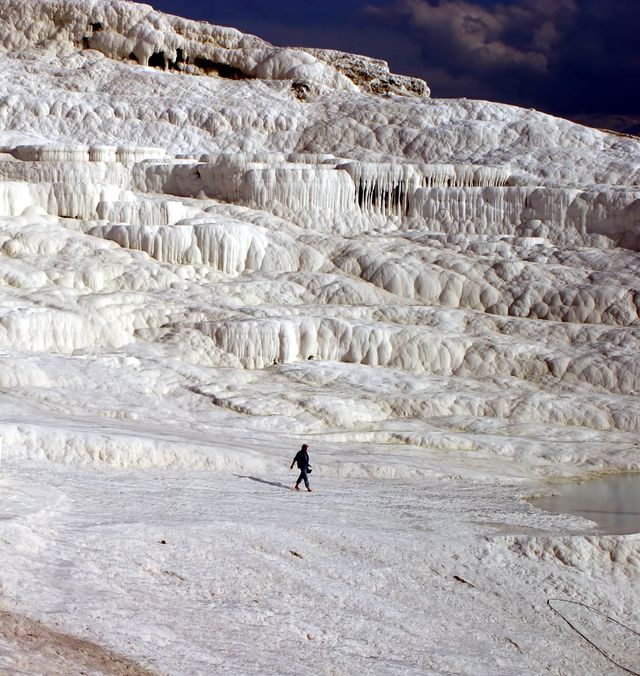
Pamukkale's white travertine terraces: the can-you-swim rules, the barefoot policy, why some pools are dry, the best time of day, and how to visit.
Attraction
Hierapolis, the Greco-Roman spa city above Pamukkale's terraces: what to see and in what order, the theatre, necropolis and Plutonium, the history, and how to visit.
Attraction
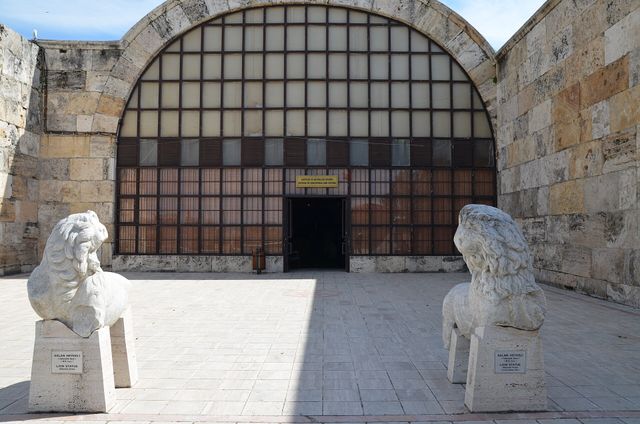
The Hierapolis Archaeological Museum at Pamukkale, Roman sculpture, sarcophagi and theatre reliefs, housed in restored ancient Roman baths.