
48 Hours in Pamukkale: A Two-Day Itinerary & Photo Diary
Most people rush Pamukkale in three hours. Give it two days and it hands you the terraces twice, at the only two times of day worth photographing them.
Most people give Pamukkale three hours. A coach drops them at the top gate near midday, they walk the white slope in the harsh flat light with a few hundred other people, take the photo, and leave. It’s the worst possible way to see the place, and it’s how the overwhelming majority of visitors do it.
Two days fixes that, and the fix comes down to one thing: the light. The terraces are only worth photographing at the two edges of the day, sunset and dawn, and both belong to people who slept in the village the night before. Stay over and you get the white slope twice with almost nobody on it, the ruins of Hierapolis in the cool of the morning, a swim among sunken Roman columns, and a whole second day for a nearby trip. Here’s exactly how I spent 48 hours in Pamukkale, hour by hour, with the photo spots, the prices, the meals, and the parts I’d skip.
A quick note on the money before we start: the single site ticket is €30 (about $33), it covers the terraces, Hierapolis and the museum, and the only paid extra inside the gates is the swim in Cleopatra’s Pool. All the euro figures below are set in lira and move with the exchange rate, so treat them as bands. The full breakdown lives on the tickets and gates page.
Day one
Early afternoon: arrive, and do almost nothing
I rolled into Pamukkale village in the early afternoon and, on purpose, wasted it. This is the single best decision I made all trip. The terraces at 2pm in summer are hot, glaring and packed with the day-trip coaches from Antalya and Izmir, so there’s no reason to hurry up there. I checked into a guesthouse, dropped my bag, and had a slow late lunch instead.
If you’re coming by bus, this is roughly when you’d land anyway. From Antalya it’s a 3.5 to 4 hour ride to Denizli (around €8 to €15), then a frequent minibus for the last 30 to 40 minutes to the village (about 50 lira, leaving every 15 to 30 minutes). Izmir is a similar 3.5 to 4 hours. The getting there hub has the origin-by-origin detail.
The village itself is small and takes about fifteen minutes to walk end to end. It’s not pretty in a postcard way, it’s a working tourist village of guesthouses and grill restaurants, but it’s friendly and everything you need is on foot. That walkability is the whole reason to stay here rather than in Denizli, 18 km off, or the spa town of Karahayıt, 5 km north. More on that trade-off in the where-to-stay section below.
5:00pm: up through the Town Gate for the terraces
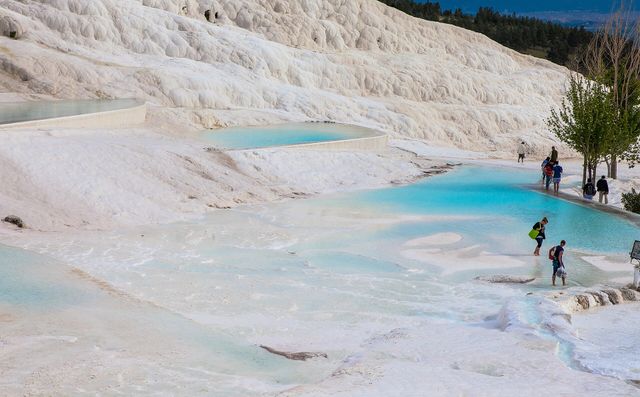
Around five I walked to the Town Gate at the bottom of the village, took my shoes off, and started up the white slope with them in my hand. Barefoot is mandatory on the travertine, no exceptions, because shoes scratch and stain the soft rock. From the Town Gate it’s a 20 to 30 minute walk up the terraces at a gentle pace, and it’s the prettiest way to arrive: you climb the thing itself rather than looking at it from a car park.
By five the day-trip coaches had gone. The path that was a slow-moving crowd at midday was down to a scattering of people, most of them, like me, staying the night. This is the difference an overnight buys you and a day tour can’t.
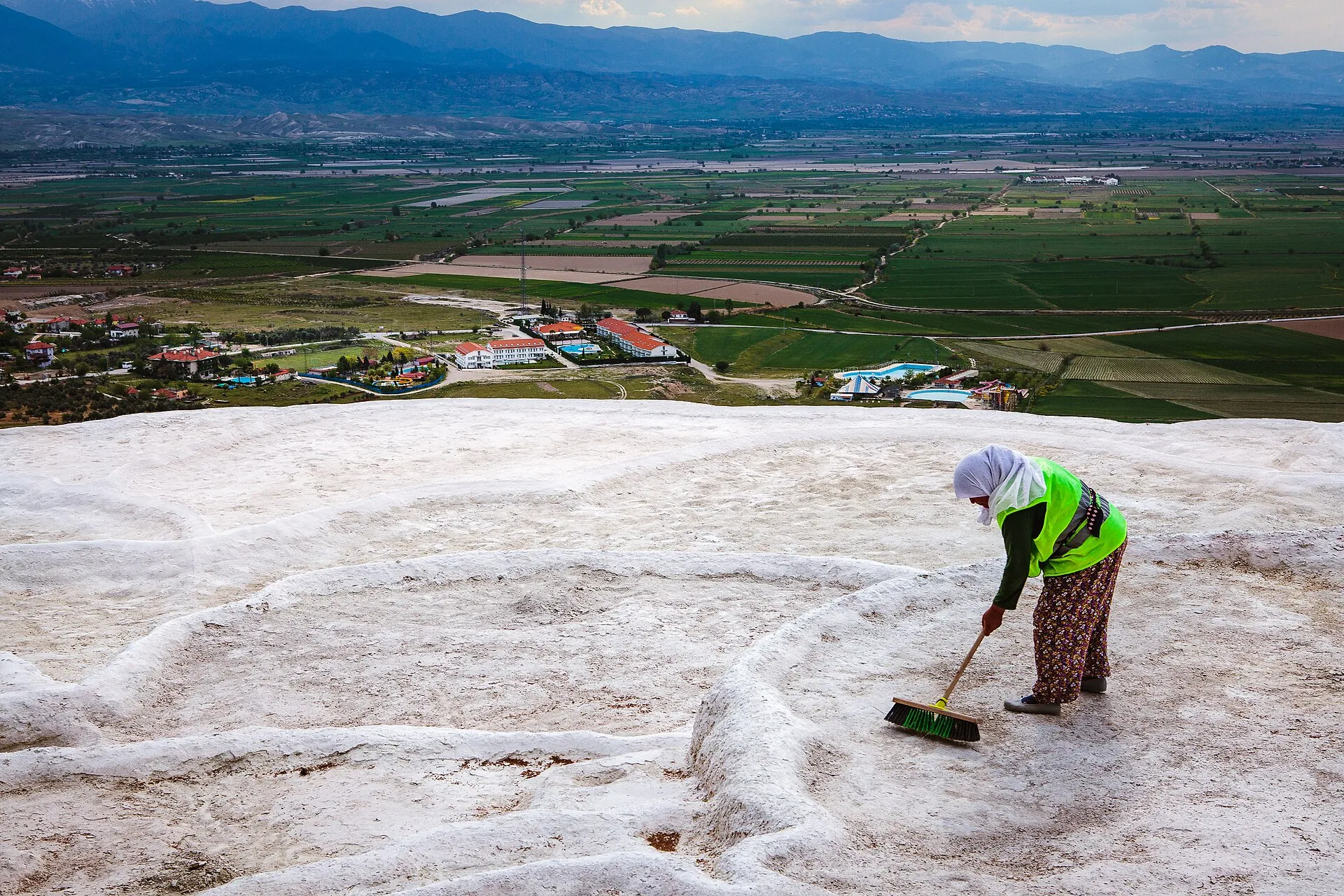
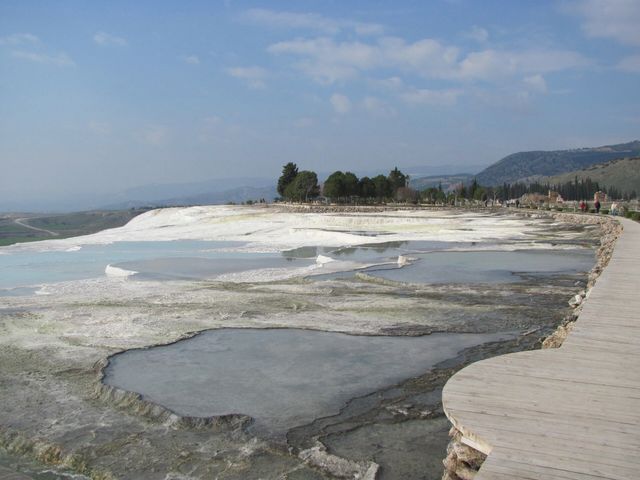
A couple of honest notes from the climb. The rock is genuinely slippery where water runs over it, so I walked slowly and planted each foot. And some terraces were bone dry and grey. That’s not decline, it’s the water-rotation system: the thermal water is moved across different sections of the slope on a schedule so each area can re-whiten, which means some pools sit empty on any given day. There’s always active water somewhere; I just followed where it was running. The full story is on the travertines page.
6:30pm to sunset: the golden hour, and the photo everyone wants
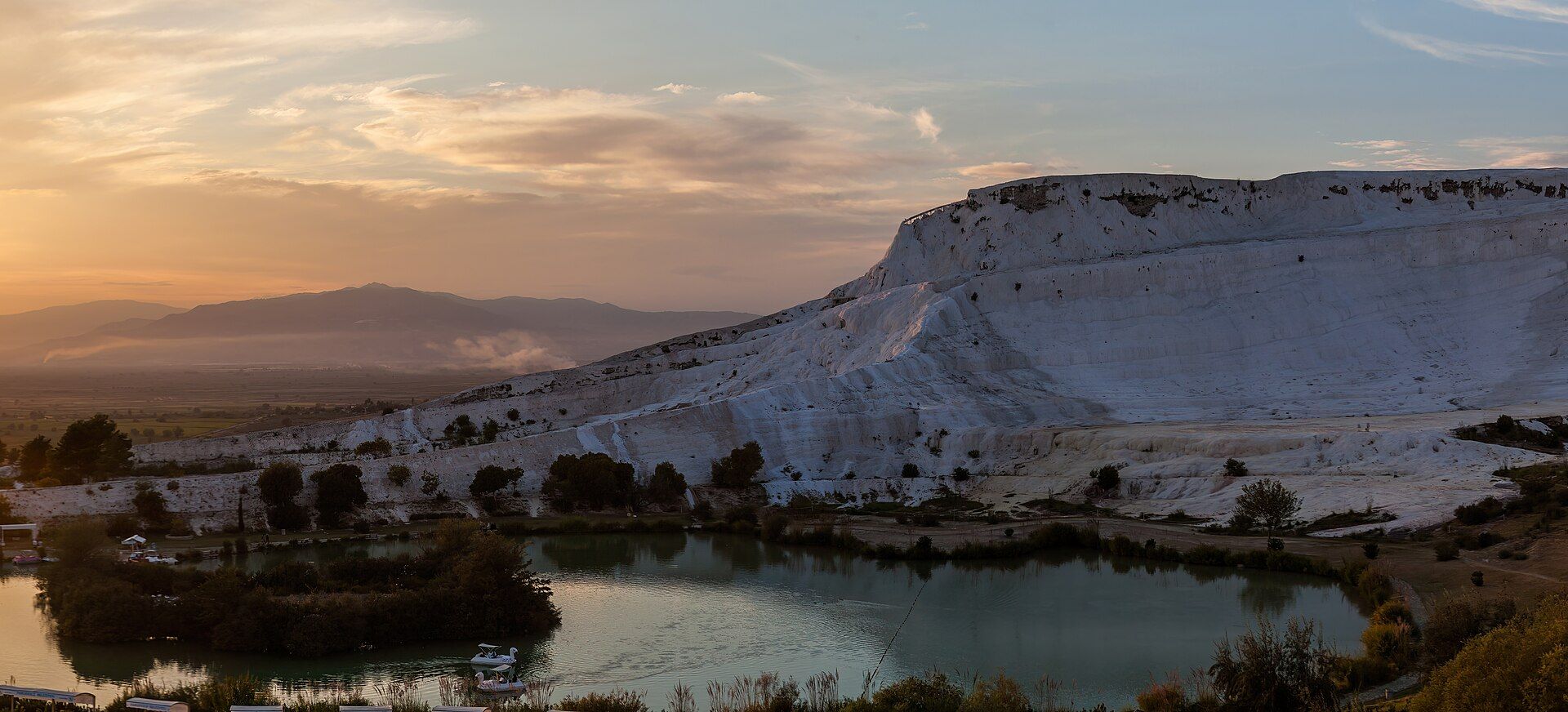
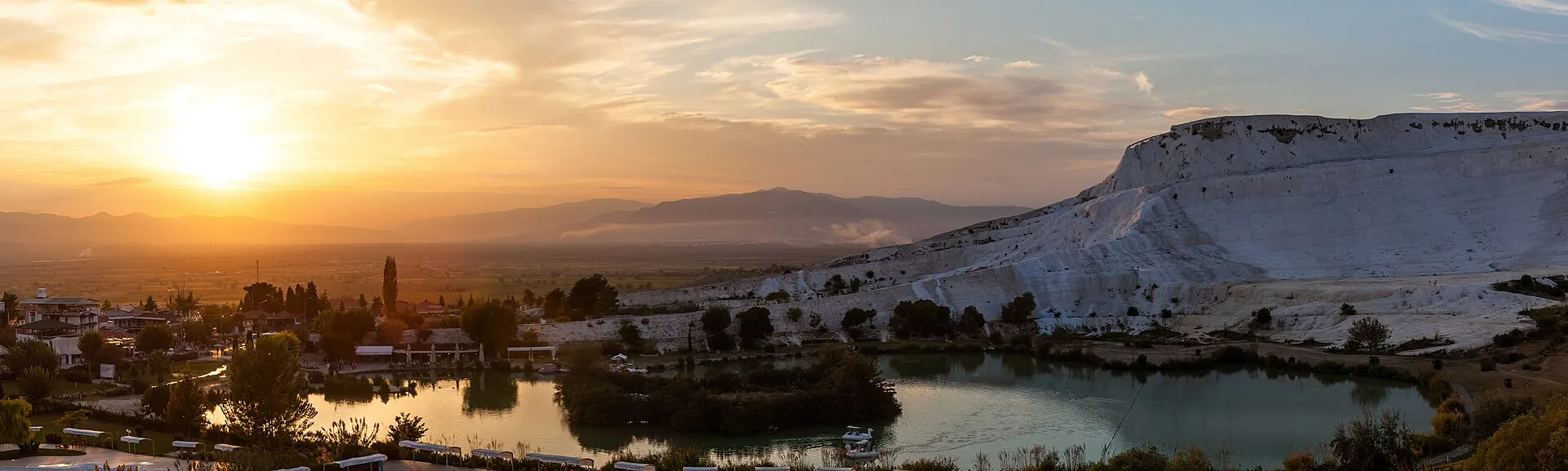
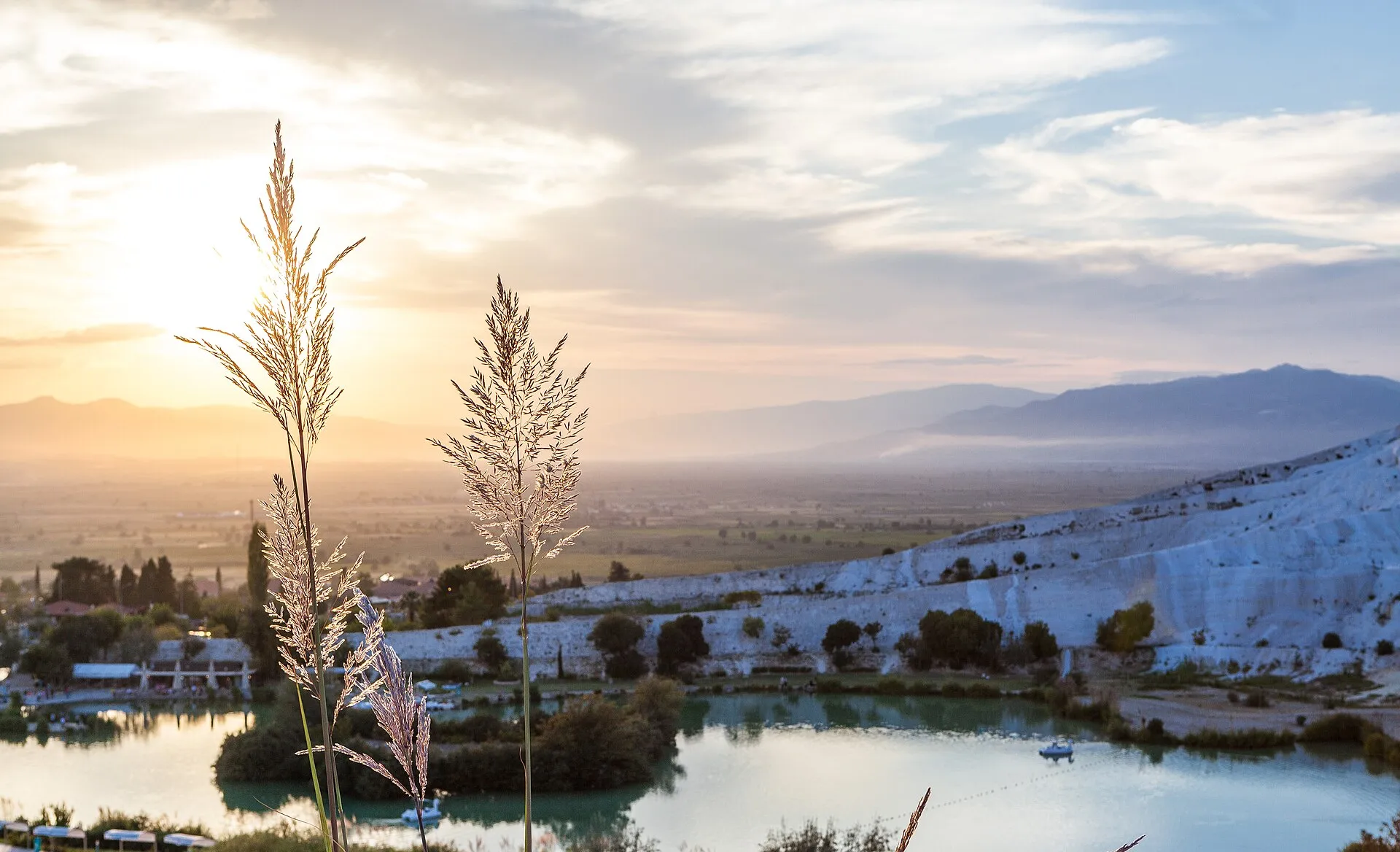
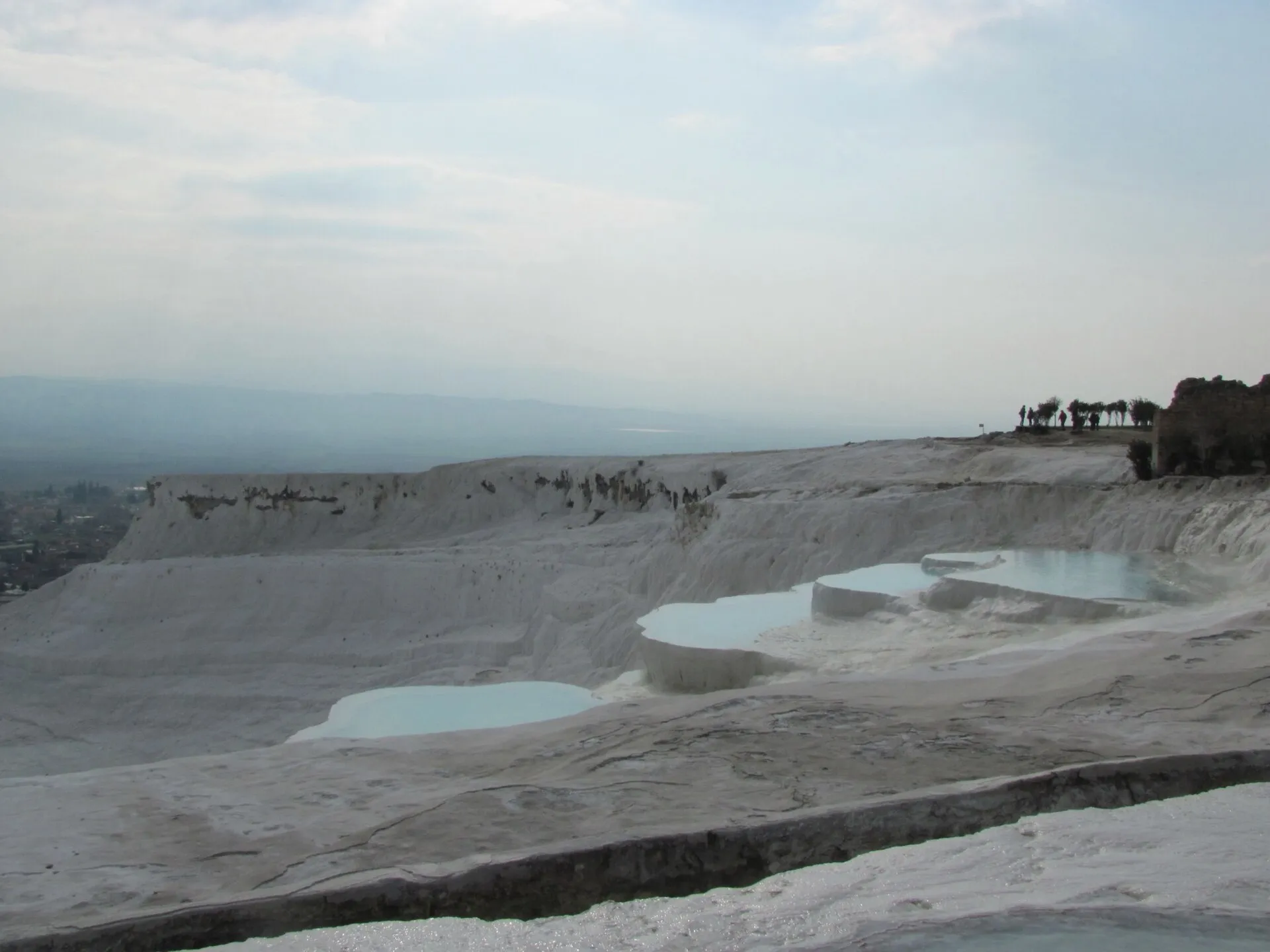
This was the hour I came for. As the sun dropped, the white travertine went warm gold, the water in the full pools turned deep blue, and the whole slope emptied until it was a handful of us and the sound of water moving over stone.
The classic shot, the one in every brochure, looks back down across the stacked pools toward the valley, and it’s best from the upper terraces in the last hour of light. I wiped my phone lens first, because the mineral mist coats everything and you don’t notice until the photos come out soft. Bring a cloth. Sunset over the terraces is the best light of the day, full stop, and it belongs to people who stayed. A day tour from the coast physically can’t be here for it.
One thing worth flagging: winter and summer put sunset at very different clock times, so check the day’s sunset before you plan your climb, and give yourself the full 20 to 30 minutes to walk up before it. The site’s summer hours run 06:30 to 21:00 (April 1 to October 1) and winter is 08:00 to 18:00, with last entry about an hour before closing.
8:00pm: dinner in the village
I walked back down in the last of the light, dried my feet, put my shoes back on, and went for dinner in the village. This is where the eating actually happens, not up at the site.
The village heavyweight is Tıkır Grill House, a Turkish grill that somehow holds 4.8 on Google Maps across more than 6,000 reviews, which is rare, since volume usually drags scores down. Mains run a wide band, roughly ₺200 to ₺1,000 depending on what you order. For a proper sit-down occasion, Hiera Restaurant is the village’s best table (4.9, reservation-only, so book ahead). If you just want a good, no-fuss Turkish meal you can walk into, Osmanlı Restaurant (4.6, nearly 4,000 reviews) does the job in the ₺200 to ₺1,000 range. Full rundown on the where to eat page.
That’s day one: nothing before 5pm, then the two best hours of light in the whole visit. The pacing feels lazy and it’s completely deliberate.
Day two
6:30am (summer) or 8:00am (winter): back for the dawn
I was at the Town Gate for opening. Early morning is the terraces’ other magic window, and it’s a different mood from the evening: cooler, softer-lit, quiet in a hushed rather than a golden way. The white looked almost blue in the first light, and the full pools sat mirror-still before the day’s first feet stirred them.
If you can only manage one of the two golden windows, this is the safer pick for solitude, because even fewer people are up at dawn than at sunset. Photographers should try to catch both. The best time to visit page goes deeper on the light, month by month.
A practical warning: at 6:30am the terrace café isn’t much use and the village restaurants may not be open yet, so I’d grabbed water and a couple of pastries the night before. Carry a snack and water up with you and eat once the sun’s properly up.
9:00am to 11:30am: Hierapolis, the city on top
By mid-morning I climbed off the terraces into the ruins that sit on top of them, and this is the part day-trippers routinely shortchange. Hierapolis is a full Greco-Roman spa city, big enough to spend half a day in, and it’s already included in your €30 ticket. Skip it and you’ve left half your ticket on the table. It rates 4.8 on Google Maps across more than 16,000 reviews.
I went to the Roman theatre first, and it stopped me for a good while. It’s cut into the hillside, one of the best-preserved theatres anywhere in Turkey (4.9 on Google Maps, the highest score of anything at Pamukkale), and you can climb the stone seating. From the upper rows you look down over the carved stage building and out across the whole ruined city to the white terraces below. It was built in the 2nd century AD under Hadrian and redecorated around AD 200 under Septimius Severus, so the standing structure is roughly 1,900 years old.
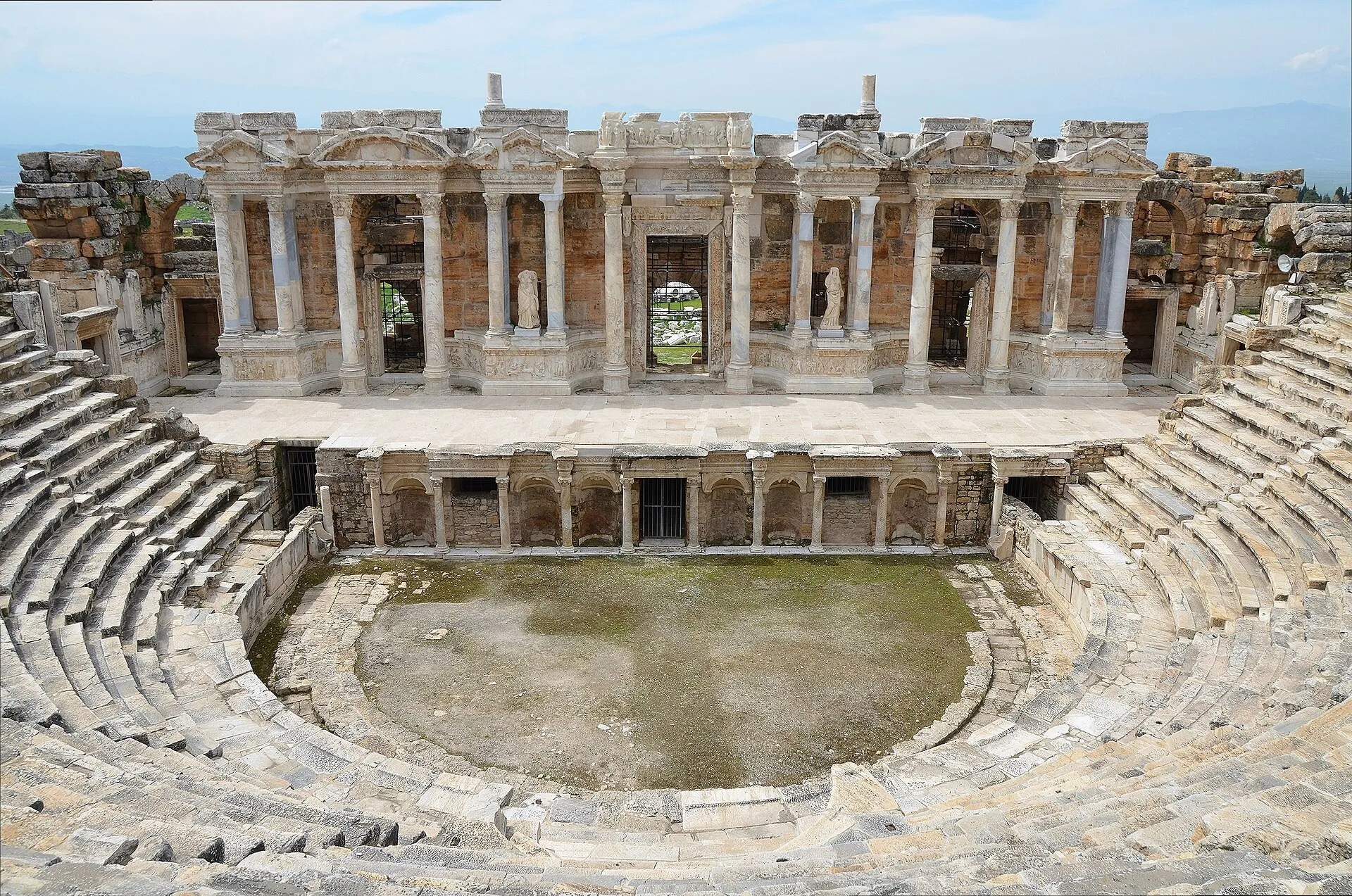
From the theatre I walked up to the Martyrium of St Philip for the best view back over the site, then came down to wander Frontinus Street, the old colonnaded main road, and looked into the strange little Ploutonion, the cave the Romans called a gate to hell because it vents carbon dioxide lethal to animals. Wear normal shoes for all of this, the barefoot rule is only for the terraces, so the ground here is easy. It’s hot and shadeless up top, though, so a morning start beats the midday climb. Give the whole city two to three hours.
11:30am: the museum, as the heat builds
As the sun got serious I ducked into the archaeological museum, housed in the old Roman baths and included in the ticket. It’s shaded and cool, worth about half an hour for the sarcophagi and statues pulled from the site, and a smart midday reset when the terraces and ruins are at their hottest and busiest.
12:30pm: lunch, then the swim in Cleopatra’s Pool
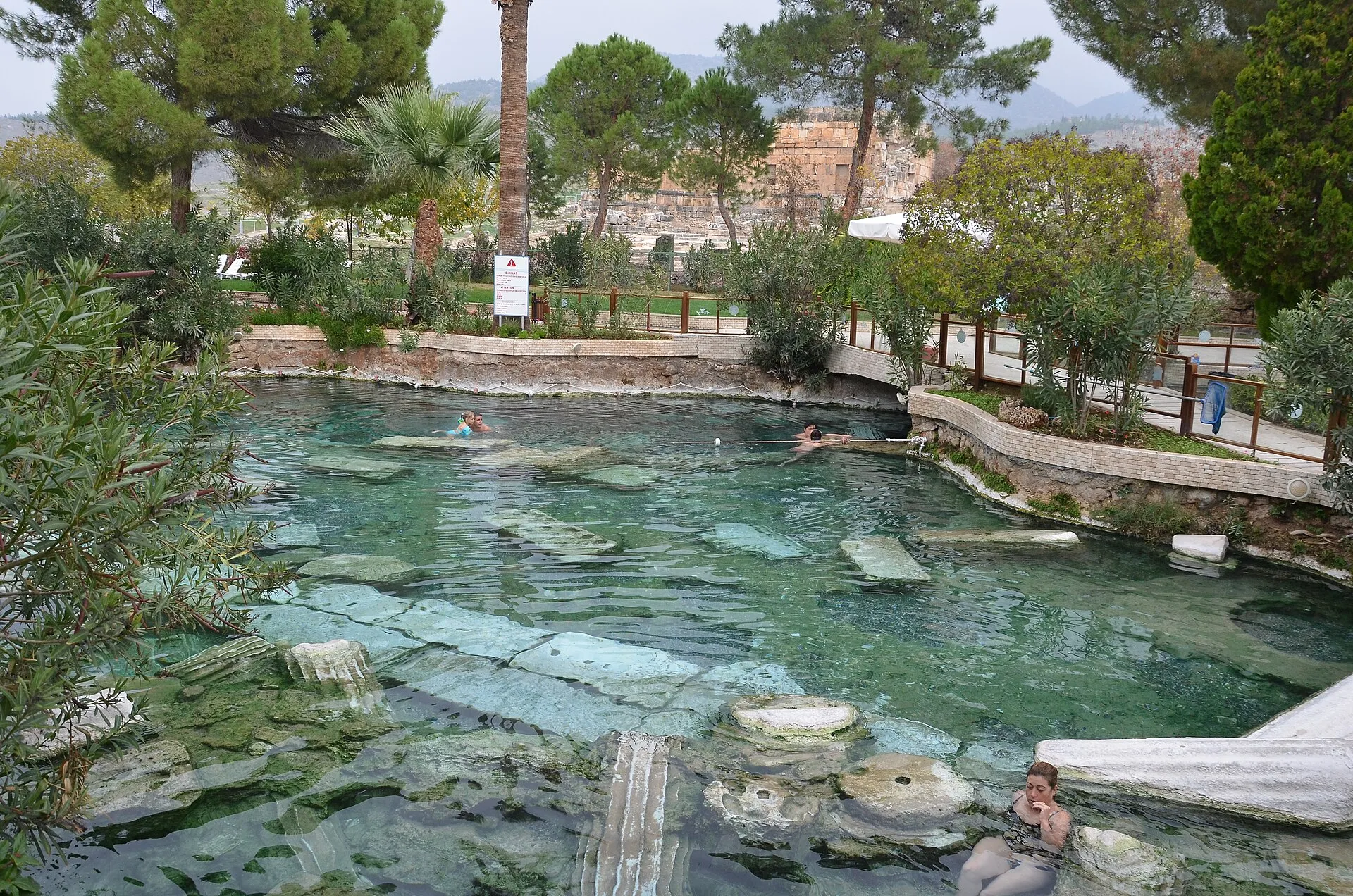
After a quick lunch I finished the morning where the Romans would have, in Cleopatra’s Antique Pool. It’s the one place at Pamukkale you can genuinely swim, a warm spring-fed pool near 36°C with chunks of ancient Roman marble lying across the bottom, columns that toppled in during an earthquake and were left where they fell. Floating over a 2,000-year-old column with warm water up to your shoulders is a strange, good feeling.
Two honest catches. First, it costs extra: around €13, paid in lira at the pool, not part of your site ticket (it’s been quoted as low as about €6 as the lira moves), for roughly two hours in the water. Second, timing is everything. Early morning it’s calm and lives up to the idea; by late morning in summer it can be a busy, noisy public bath you paid a premium to enter. That split is exactly why it rates a lower 4.2 on Google Maps than the terraces or the theatre. My take: worth it if you go early and like a thermal soak, easy to skip if you’re tight on time or budget or it’s peak midday. The pool reopened in 2026 after a renovation that added changing rooms, rest areas and a cafe, so getting changed is easier than it used to be.
Afternoon: the nearby trip
By early afternoon on day two you’ve seen everything on the hill, and this is where the second day really pays off: a trip to somewhere the day-trippers never reach. I’ll give you both options, because they suit different travellers.
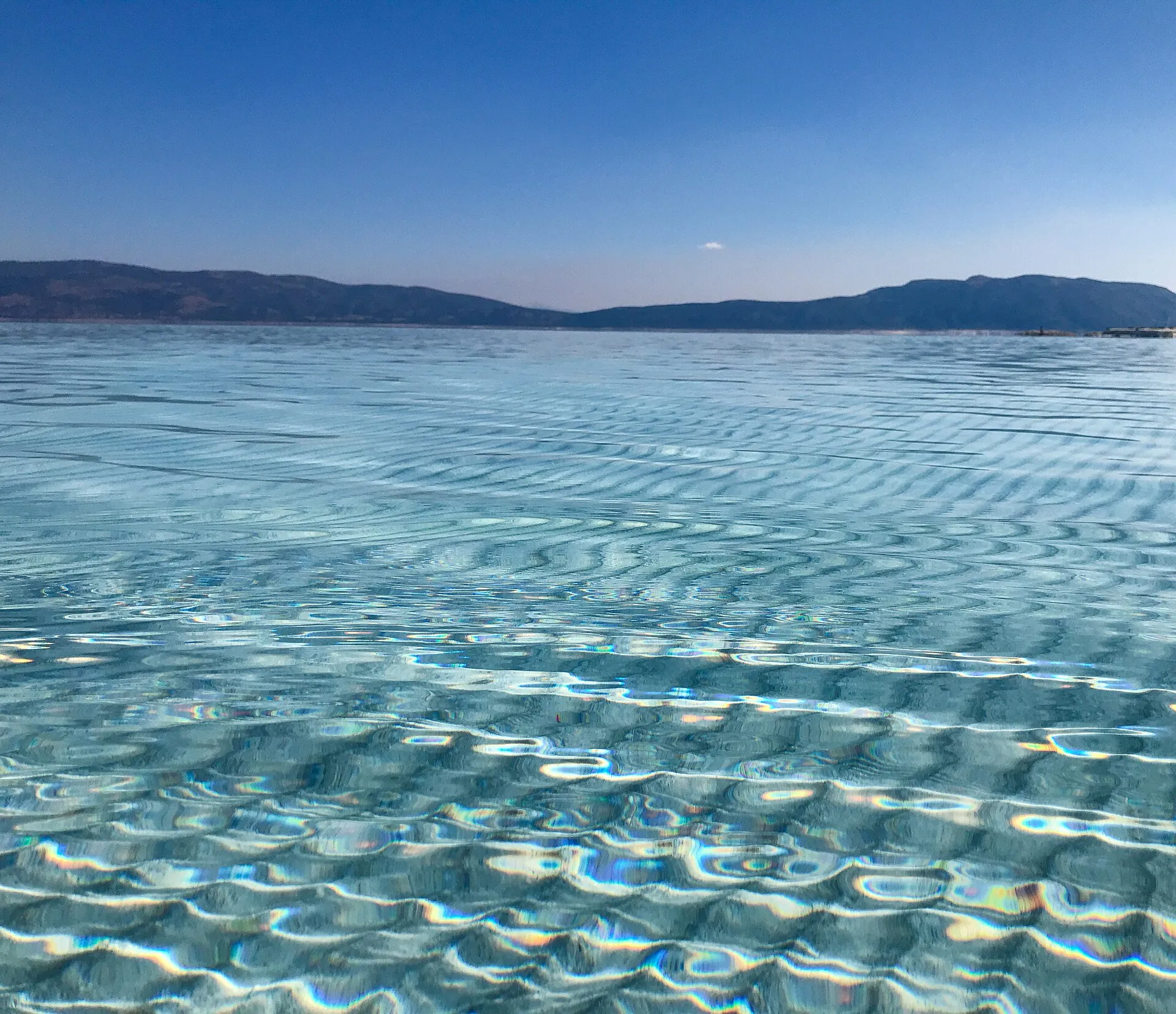
The bigger, more spectacular one is Salda Lake, a deep crater lake fringed with brilliant white mineral beaches, where the pale shore meets the water in a band of luminous turquoise. The nickname “Turkey’s Maldives” is marketing, but standing on the shore you see where it came from. The white sand is hydromagnesite, and the lake is unusual enough that NASA has studied it as an earthly stand-in for Mars, since the Perseverance rover’s landing site holds similar minerals. It rates 4.5 across nearly 13,000 Google Maps reviews.
The catch is distance: Salda is about 90 minutes each way with no useful public transport, so you need a car or a tour, and it’s a full half-day, not a quick stop. If you drove here or rented wheels, it’s a brilliant use of a second afternoon (bring a swimsuit in summer). If you didn’t, it’s the one part of this itinerary that needs planning ahead.
The easier option, if a 90-minute drive doesn’t appeal, is Laodicea, a huge ancient city only about 15 minutes from Pamukkale, doable by taxi. It’s one of the largest ancient cities in Turkey, still under active excavation, with two theatres, a long stadium, and a re-erected colonnaded avenue you can walk down. It was one of the Seven Churches of Revelation, the congregation famously called “lukewarm.” Most Pamukkale visitors never come, which is the appeal: you can wander a major Roman city in near silence. It rates a remarkable 4.8 across nearly 5,000 reviews. It’s on a separate ticket (its own gate, not covered by the Pamukkale ticket), and one to two hours does it.
Which to choose? Salda for the colour and the swim if you’ve got a car and a free half-day. Laodicea for ruins and quiet if you don’t want the drive. Either way, the day trips hub has the rest.
Evening: sunset again, or the road out
If you’re leaving on the evening of day two, aim to be gone before you’d otherwise be climbing back up for another sunset, and don’t torture yourself over missing it, you already caught two golden windows. If you have the second night, though, a final sunset on the terraces is never a mistake, and it’ll be just as empty as the first.
Where to stay for two days
Stay in Pamukkale village. This isn’t a close call. The village sits at the foot of the white slope, a few minutes from the Town Gate, and it’s the only base that lets you walk up for sunset and be back at the gate for dawn. That double-golden-hour is the entire reason to spend two days here, and you forfeit it from anywhere else.
Village guesthouses run roughly €60 to €170 a night in 2026, moving with the season. At the comfortable end, Paradise House (9.2 on Booking.com across more than 1,000 reviews) and Akapella (9.1) are among the top-rated, around €100 to €170. For a tighter budget, simpler well-reviewed spots like Hotel Pamukkale and Aspawa start nearer €60 to €80. The where to stay page has the full picture.
The two alternatives both cost you the early light. Karahayıt, 5 km north, has the larger thermal-spa resorts if a hotel with its own heated pools is the point of your trip. Denizli, the city 18 km away, is cheaper and better connected for onward buses, trains and flights. Both are a drive from the gates, so neither works for the dawn terraces, which for a two-day visit is the thing you’re paying for.
What to skip, and honest pacing notes
A few things I’d tell a friend.
Skip the cafés at the top of the site for anything more than a cold drink. They’re captive-audience spots, pricier and more ordinary than the village, so save your meals for down the hill.
Don’t force the balloon into 48 hours unless the weather is clearly settled and you’ve booked it for the first morning. Sunrise hot-air balloon flights over the terraces are lovely and cheaper than Cappadocia’s, roughly €100 to €180 per person, but they cancel often for wind and cloud, and a cancellation eats a morning you needed for Hierapolis. If it’s a must-do, book it for day two’s dawn and treat it as a maybe.
Don’t try to do both Salda Lake and Laodicea in one afternoon. Salda alone is a half-day round trip. Pick one.
And don’t skip Hierapolis to spend longer on the terraces. I know the white slope is why you came, but you’ve already got it at both sunset and dawn, and the ruins are half of what your ticket paid for. An hour of harsh midday terrace time is worth far less than an hour in the theatre.
On pacing: this itinerary front-loads the light onto the edges of the two days and leaves the harsh middles for the ruins, the museum and the pool, which don’t care about the sun the way a photo does. It’s unhurried by design. If you’d rather compress everything into one day, or you only have one, the itinerary page has a tight single-day version. But if you can spare the night, the terraces twice in the right light is the whole argument for 48 hours in Pamukkale, and it delivers.
FAQ
Is two days too long for Pamukkale? No, but it’s the upper limit for the town itself. One full day covers the terraces, Hierapolis and a swim in Cleopatra’s Pool. The second day earns its keep only if you use it for the light (catching the terraces at both sunset and dawn) plus a nearby trip like Salda Lake or Laodicea. If you’re not fussed about photos or a day trip, one full day is genuinely enough, and the itinerary page makes that case.
What’s the best time of day to photograph the Pamukkale terraces? Late afternoon into sunset, and again right at opening. The low sun turns the white travertine warm gold and the pools deep blue, and both edges of the day are when the coach crowds are gone. Midday is the worst: flat overhead glare, harsh reflections off the white rock, and the path at its busiest. Stay overnight in the village and you can shoot both golden windows, which a day-tripper never gets to do.
Can you do Salda Lake and Pamukkale in the same trip? Yes, but Salda is a full half-day on its own. It’s roughly 90 minutes each way by car, with no useful public transport, so you’ll need a rental or a tour. Budget the whole of a second morning and early afternoon for it. If a long drive doesn’t appeal, Laodicea is only about 15 minutes from Pamukkale and makes a far shorter add-on.
Do I need a car for 48 hours in Pamukkale? Not for the terraces, Hierapolis or the village, which are all walkable from a village guesthouse. You only need a car (or a tour) if you want to reach Salda Lake, about 90 minutes away with no easy bus. Laodicea, 15 minutes off, is doable by taxi. So: no car for a village-only two days, a car or tour if Salda is on your list.
Where should I stay for a two-day Pamukkale visit? In Pamukkale village, at the foot of the terraces. It’s the only base that lets you walk to the Town Gate for sunset and be back at opening for dawn, which is the entire point of staying two days. Village guesthouses run roughly €60 to €170 a night in 2026 depending on the place and season. Karahayıt’s spa hotels and the city of Denizli are cheaper or comfier, but both are a drive from the gates and cost you the early light.
Frequently asked questions
Is two days too long for Pamukkale?
No, but it's the upper limit for the town itself. One full day covers the terraces, Hierapolis and a swim in Cleopatra's Pool. The second day earns its keep only if you use it for the light (catching the terraces at both sunset and dawn) plus a nearby trip like Salda Lake or Laodicea. If you're not fussed about photos or a day trip, one full day is genuinely enough, and the itinerary page makes that case.
What's the best time of day to photograph the Pamukkale terraces?
Late afternoon into sunset, and again right at opening. The low sun turns the white travertine warm gold and the pools deep blue, and both edges of the day are when the coach crowds are gone. Midday is the worst: flat overhead glare, harsh reflections off the white rock, and the path at its busiest. Stay overnight in the village and you can shoot both golden windows, which a day-tripper never gets to do.
Can you do Salda Lake and Pamukkale in the same trip?
Yes, but Salda is a full half-day on its own. It's roughly 90 minutes each way by car, with no useful public transport, so you'll need a rental or a tour. Budget the whole of a second morning and early afternoon for it. If a long drive doesn't appeal, Laodicea is only about 15 minutes from Pamukkale and makes a far shorter add-on.
Do I need a car for 48 hours in Pamukkale?
Not for the terraces, Hierapolis or the village, which are all walkable from a village guesthouse. You only need a car (or a tour) if you want to reach Salda Lake, about 90 minutes away with no easy bus. Laodicea, 15 minutes off, is doable by taxi. So: no car for a village-only two days, a car or tour if Salda is on your list.
Where should I stay for a two-day Pamukkale visit?
In Pamukkale village, at the foot of the terraces. It's the only base that lets you walk to the Town Gate for sunset and be back at opening for dawn, which is the entire point of staying two days. Village guesthouses run roughly €60 to €170 a night in 2026 depending on the place and season. Karahayıt's spa hotels and the city of Denizli are cheaper or comfier, but both are a drive from the gates and cost you the early light.
Where to eat nearby
-
Tıkır Grill House
The area's heavyweight: by far the most-reviewed restaurant around Pamukkale and still highly rated, which is rare since popularity usually drags scores down. A Turkish grill at heart, so come for kebabs and grilled meat. That rating-on-huge-volume pattern suggests it earns its popularity despite sitting near the site, rather than trading on location.
-
Hiera Restaurant
The village's special-occasion table, and reservation-only, so it's a planned dinner rather than a walk-in. A more refined sit-down meal with prices to match. Book ahead in peak season.
-
Osmanlı Restaurant
One of the most-reviewed places in the village, which points to a dependable, unpretentious all-rounder. Leans to Turkish meat dishes and kebabs, easy walk-in, mid-range. A sensible default for a good Turkish meal without deciding too hard.
Related reading
Blog
Pamukkale Barefoot Rules & What to Wear (2026)
Shoes off, swimsuit on, dry bag packed. The simple kit that turns the barefoot walk into the best part of the day.
Blog
Pamukkale in Winter: Worth It? (What to Expect)
Cold air, warm water, empty terraces, and cold feet. Here's who winter works for and who should wait.
Blog
Pamukkale vs Cappadocia: Which Should You Choose? (2026)
Two very different trips. Here's how to pick, and how to do both.